Featured snippet answer: Recruiting one participant takes roughly an hour of work on average (NN/g). That is the actual bottleneck, not the research itself. The fix is matching evidence effort to decision risk, not skipping validation.
Excerpt: Recruiting, not research itself, is what is actually slowing your team down. Here is how to match evidence effort to decision risk instead of skipping validation entirely.
TL;DR
Recruiting one participant takes roughly an hour of work on average (Nielsen Norman Group); that's the real bottleneck, not the research itself.
Faster recruiting tools still cost an hour-plus per person. Recruiting-free synthetic testing is fast but shouldn't carry every decision.
The fix: match the evidence method to what a decision costs if it's wrong, using a four-step Evidence Ladder from AI critiques through real participant recruiting.
Low-stakes calls get answered in minutes with AI critiques or synthetic audiences trained on your customer data. High-stakes, hard-to-reverse calls still deserve real recruited participants.
Your last sprint review ended the way most of them do: a feature shipped, nobody had validated it with a real user, and someone asked, "should we have tested this first?" three weeks too late to matter.
Nobody on the team disagreed that research would've helped. What they disagreed on, silently, was who had four hours to spend recruiting five people for a study that needed to happen yesterday.
That's the real problem. It was never that teams don't value user research. It's that recruiting eats the time budget before the research even starts.
Recruiting is the bottleneck, not the research
Participant recruitment, not the research method itself, is the single biggest time cost in most user research projects. It takes roughly an hour of screening, scheduling, and follow-up to land one qualified, confirmed participant before any actual research happens.
Nielsen Norman Group's own recruiting research puts the average cost of finding one qualified usability testing participant at just over an hour of active work: screening, scheduling, chasing no-shows, confirming again the day before. For a five-person study, that's most of a workday spent before a single insight comes back. Add specialized criteria (enterprise buyers, clinicians, developers), and that number climbs fast.

Design and code now move at AI speed. Recruiting still moves the way it did a decade ago: an email, a spreadsheet, a Calendly link, and a hope that people show up. That gap is exactly what's straining most teams' research velocity right now: the distance between when a question comes up and when you actually have an answer worth acting on.
NN/g's recruiting data also puts the average research no-show rate at 11%, which means every study needs padding built in from the start. That's one more thing to plan around, one more delay if the math doesn't work out.
So teams do the rational thing under a deadline: they skip it. Not because they don't care about the user, but because a full recruiting cycle before every decision doesn't scale to how fast they're shipping now.
Why the problem is getting worse, not better
Design and code got 10x faster. Validation didn't. That gap is the single biggest risk in product development right now, and it's compounding every sprint.
Teams that used to ship a handful of releases a quarter now ship weekly, sometimes daily, with AI doing a large share of the design and engineering work that used to take the most time. Recruitment didn't get any faster to match. The result is a widening gap between how quickly a team can produce something and how quickly they can find out whether it's any good, and the wider that gap gets, the more research quietly gets skipped altogether, not just delayed.
That's the trap worth naming directly: the instinct under pressure is to treat "no time to recruit" as "no time for research." Those aren't the same problem, and confusing them is what leads teams to ship blind rather than ship smart. Even well-staffed research ops functions feel this squeeze, because moderated usability testing and unmoderated usability testing both still run on the same recruiting pipeline underneath. The result: teams keep shipping decisions nobody validated.
Why "just recruit faster" doesn't actually fix it
Most advice on this topic solves the wrong layer of the problem. Panel tools promise faster access to participants: a real improvement over cold outreach, and worth using when you genuinely need real people. But faster recruiting is still recruiting. It still assumes every decision deserves the same weight of evidence, which is the assumption that's actually breaking down.
Not every decision does. Whether a button label reads clearly to a first-time user isn't the same kind of decision as whether to ship a new onboarding flow to your entire customer base. Treating them identically means either overinvesting in the small call or underinvesting in the big one, and under time pressure, teams almost always default to underinvesting in both.
Synthetic Audiences change the math entirely
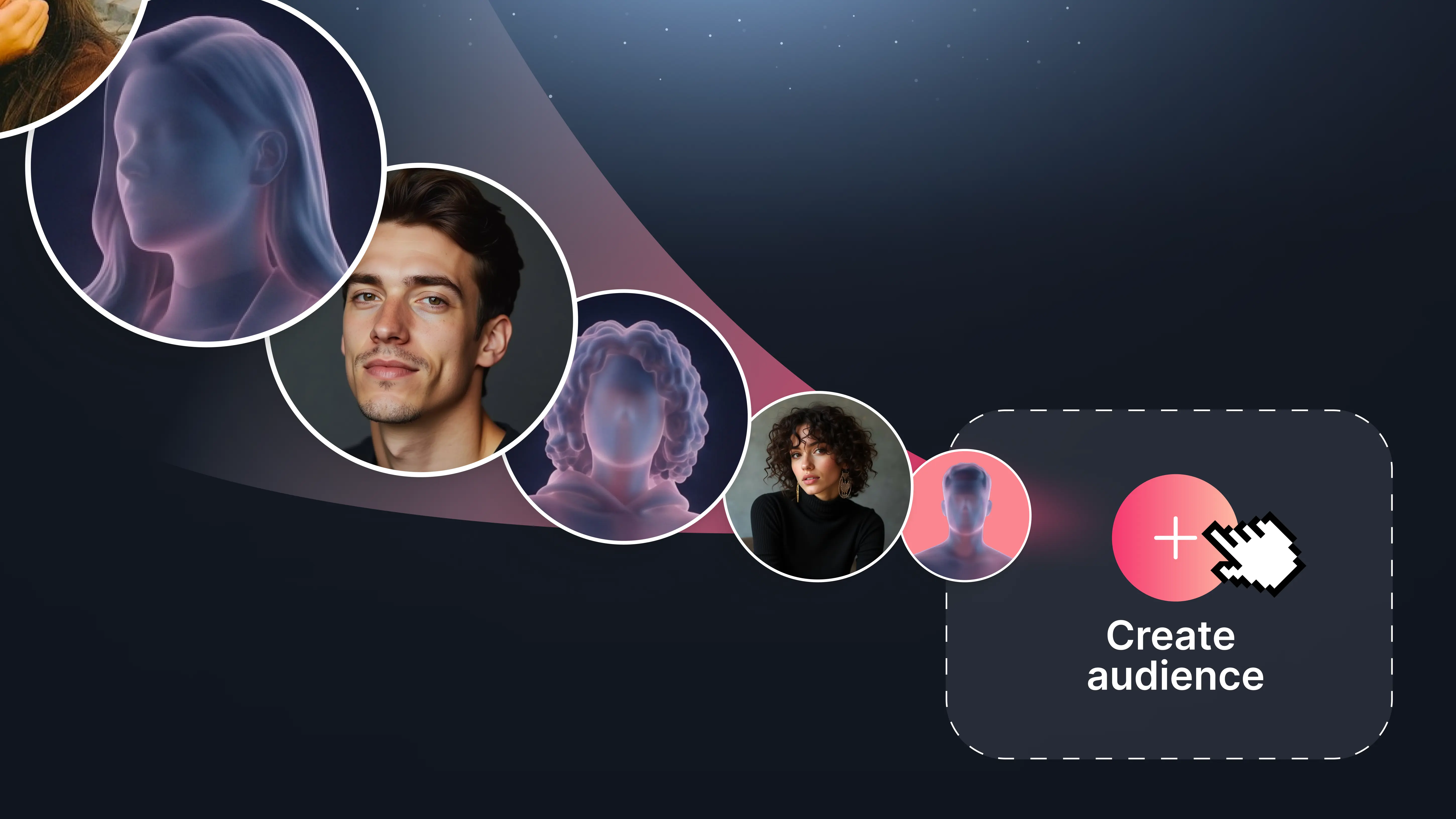
This is where Synthetic Audiences stop being a novelty and start being the fastest tool in your kit. Trained on your customer data, custom AI profiles act like real customers: they follow instructions, share their screen as they use your flow, and talk through their reasoning out loud, exactly the way a moderated session would, minus the hour of recruiting and the day of waiting. What used to be a three-week validation cycle turns into an afternoon. Validation in minutes, not weeks.
Used well, this is a genuine unlock, not a workaround: catch an obviously confusing flow before it reaches a real participant, pressure-test a discussion guide so your questions aren't leading, compare three rough directions in the time it takes to write the prompts instead of the time it takes to schedule three studies, and surface edge cases you hadn't thought to test for. A synthetic audience that catches a confusing question in your interview script saves you from burning an actual recruited participant's time finding the same thing out the hard way.
And because they don't need recruiting, they can run right where you build. TheySaid MCP works inside Claude Design, v0, Replit, Bolt, and Lovable: ask for feedback on a design you just generated, and you get it back with a ready-to-use prompt to fix what testers struggled with. Ticket testing goes a step further. When a Jira ticket hits design-done, validation runs on its own, so nobody has to remember to ask.
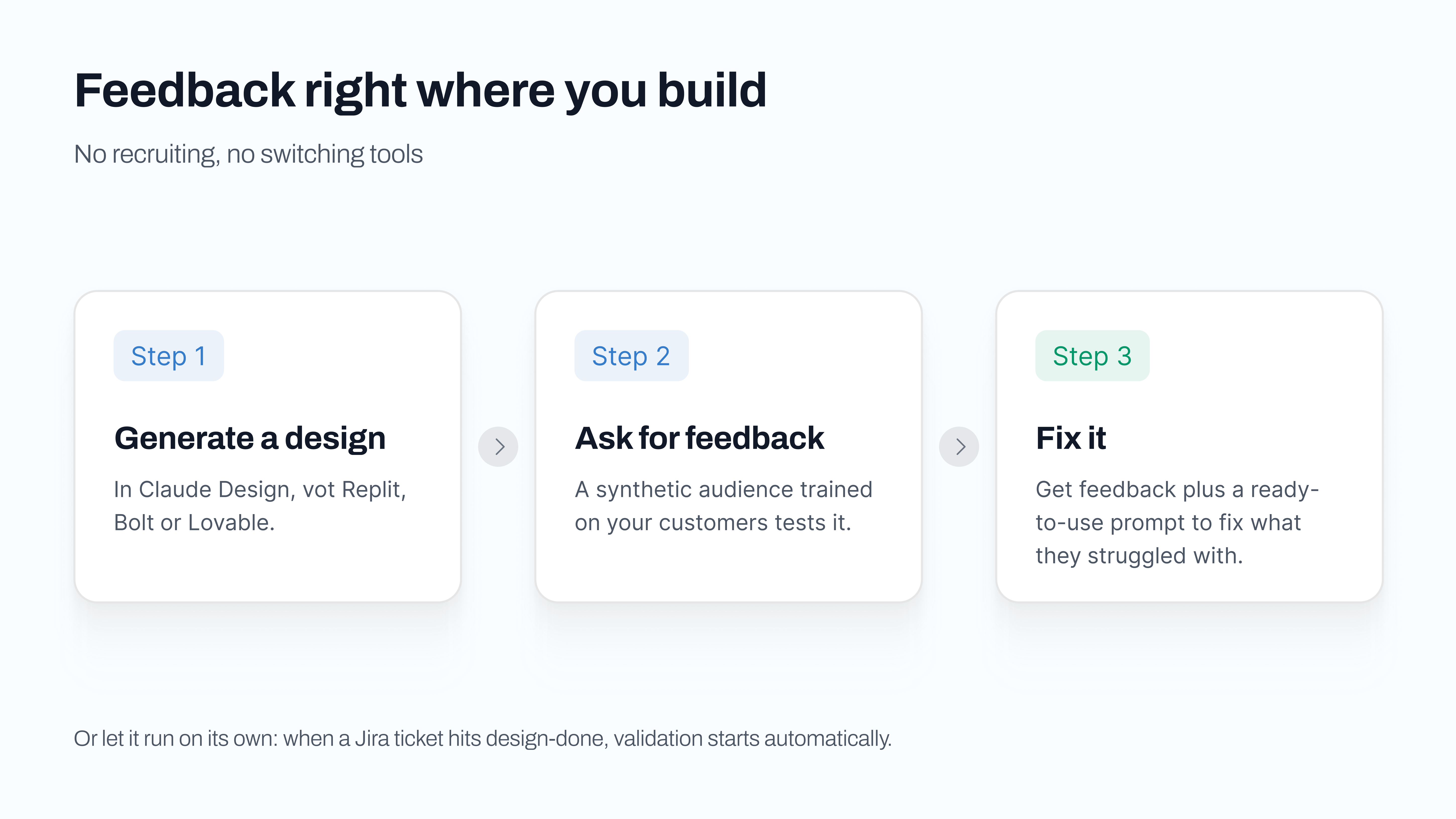
That's the whole point of building this into the workflow instead of bolting it on afterward: embedded, not adjacent. Evidence, not opinions. Gates, not gatekeepers. Validation that keeps pace with how fast you're already building. Validation is no longer a project. It's infrastructure.
Your product moves fast. Your research should too.
Validate ideas, prototypes and experiences faster.

Where the ladder still climbs higher
Even the fastest synthetic signal has a ceiling, and it's worth being straight about where it sits. Nielsen Norman Group's own evaluation of AI-simulated users found they can miss the "messy, nuanced" texture of real human behavior in the decisions that carry the most weight. For a closer look at where synthetic testing holds up and where it doesn't, see Busting the Biggest Myths About Synthetic Testers.
That's not a knock against synthetic testing. It's exactly why the Evidence Ladder exists: use Synthetic Audiences to move at full speed on the calls that can take it, and climb to real participants for the ones where a wrong guess is expensive. Knowing which rung you're on is the skill. Having both rungs available, in one platform, is the unlock. With TheySaid's Audiences, you build human and synthetic audience profiles side by side, and the Unified Test Builder runs either one from the same study.
A framework for matching evidence to the decision
Here's the question worth asking before every research request: what does it actually cost if this decision turns out wrong?
- Low-stakes, reversible calls: copy tweaks, minor flow changes, "does this even make sense" checks. Use an AI-moderated critique or a synthetic audience. You'll have an answer in minutes, and if it's wrong, the cost of finding out later is small.
- Medium-stakes calls with real ambiguity: comparing two design directions, pressure-testing a new concept before it goes to engineering. Synthetic audiences earn their keep here too, specifically for surfacing where a concept is likely to confuse people, before you spend a recruiting cycle finding out the same thing more slowly.
- High-stakes, hard-to-reverse calls: a pricing change, a new onboarding flow, anything touching your entire user base. This is where real participant recruitment still matters. NN/g's own findings on synthetic-user limitations are exactly why: a decision this size deserves a participant who might actually push back.
The point isn't "AI good, humans bad" or the reverse. It's that the two answers different research methods are good at giving line up neatly with how much a wrong answer actually costs you. Spend recruiting time where being wrong is expensive. Skip it where it isn't.
The Evidence Ladder: four levels of proof, from minutes to days
The Evidence Ladder is a four-step framework for matching a research method to how much confidence a decision needs. It runs from immediate AI critiques up to continuous post-release monitoring, and it's a ladder rather than a binary choice between "fast and synthetic" or "slow and real"; each rung answers a different question, at a different speed.

- Expert AI Critiques: "Did we execute this correctly?" Immediate. Best for every iteration, requirements and flows, UX and accessibility checks.
- Synthetic Audiences: "How are target audiences likely to react?" Minutes. Best for comparing directions, pressure-testing concepts, exposing obvious friction. Trained on your customer data, so the reactions reflect the people you actually build for.
- Human Customer Evidence: "Do we have enough real-world confidence?" Hours to days. Best for major commitments, final prototypes, and behavior that depends heavily on context.
- Product & Experience Outcomes: "Did it actually work after release?" Continuous. Best for task success, adoption, and measuring real impact once something ships. TheySaid's Experience Hub monitors and scores your critical customer experiences here, with recommendations for what to improve.
Climbing the ladder costs more time at every rung. The skill isn't climbing to the top by default; it's knowing which rung a specific decision actually needs, and stopping there.
Test before you recruit.
Use Synthetic Audiences to catch friction before real participants.

What this looks like in practice
A product manager, prepping for a sprint review
A product manager doesn't need a five-person moderated study to know whether a new empty state is confusing. A synthetic audience or an AI critique answers that in the time it takes to write the prompt, and it's the right tool for that specific question.
The same PM, deciding whether to change how the entire product's pricing page works, needs actual customers reacting to it: people who'll say the price feels wrong even when the AI thinks the copy is clear, because a model has never actually paid for anything.
A designer, comparing two directions before a build starts
A designer with two competing layouts for an onboarding flow doesn't need to pick a winner by committee debate or gut feel. Running both past a synthetic audience surfaces which one causes obvious confusion in minutes, cheaply enough to try again if neither one lands. With TheySaid MCP, that happens without leaving the design tool. That's a decision worth making fast, because it's still reversible; nothing has shipped yet.
A researcher, protecting a real study from a bad question
Even when a study genuinely needs real recruited participants, a researcher can pilot the think-aloud script against a synthetic persona first. Confusing phrasing, leading questions, and dead-end tasks are cheap to catch this way and expensive to discover mid-session with someone you spent an hour recruiting.
This is the logic behind TheySaid's Evidence Ladder: Expert AI Critiques and Synthetic Audiences for the fast, iterative calls, and real participant recruiting, whether that's a vetted panel or your own existing users, for the ones where confidence has to come from a real person. The point isn't picking a side between synthetic and human. It's not paying for more evidence than a decision needs, and not settling for less than it does.
Three things to do before your next research request
- Name the actual cost of being wrong, out loud, before picking a method. If nobody can say what breaks if the decision is wrong, that's usually a sign it's a smaller call than it feels like under deadline pressure.
- Use synthetic audiences to pilot your research plan, not just the product. Running your actual discussion guide against a synthetic audience first catches confusing questions before they cost a real recruited participant's time.
- Reserve recruiting hours for the decisions that will still matter in six months. Every hour spent recruiting for a reversible call is an hour not available for the one that isn't.
None of this makes the recruiting problem disappear. A one-hour-per-participant cost is still real, and for the decisions that need real customers, that cost is worth paying. What changes is how often you're forced to pay it, because most of what's currently stuck in a recruiting queue never needed a queue in the first place.
Make Validation Match the Speed of Your Product Team
You don't need to choose between moving fast and doing good research. You need a faster way to decide which questions deserve real participants and which ones can be answered before recruiting ever starts.
TheySaid gives product teams both. Use Expert AI Critiques and Synthetic Audiences trained on your customer data to pressure-test ideas, prototypes, and research plans in minutes. When a decision carries more risk, recruit real participants and bring that evidence into the same workflow.
It all runs where you already work. TheySaid MCP brings feedback into Claude Design, v0, Replit, Bolt, and Lovable. Ticket testing validates every design before it moves to development. AI Companion runs a study for you when you tell it what you want validated. And Experience Hub keeps listening after launch.
The goal isn't to replace human research. It's to stop spending human research time on questions that don't need it and make sure the questions that do get the attention they deserve. Stop shipping decisions nobody validated.
FAQ
Is it actually okay to skip recruiting real participants for some research?
Yes, for decisions where being wrong is cheap to fix: copy, minor flow tweaks, early concept checks. Nielsen Norman Group's own research on AI-simulated participants found real gaps in the questions that matter for bigger, harder-to-reverse decisions, so the skip only holds for the lower-stakes end.
How long does it realistically take to recruit five research participants?
Based on NN/g's average of roughly an hour of work per participant, budget close to a full workday for five people, more if you need specialized criteria like a specific job title or industry, and pad for an average 11% no-show rate.
Can synthetic testers replace a UX researcher's recruiting process entirely?
No. Synthetic testers are strongest for fast iteration and pre-testing a research plan before you spend real recruiting time on it. NN/g's evaluation found AI-simulated users tend to miss the nuanced, sometimes contradictory texture of real human behavior, which is exactly the failure mode you can't afford on a high-stakes decision.
What's the fastest way to get feedback on a prototype with zero time to recruit?
Run it past an AI critique or synthetic audience first to catch obvious confusion. If you're building in Claude Design, v0, Replit, Bolt, or Lovable, TheySaid MCP does this without leaving the tool. Then decide whether the finding is big enough to justify recruiting a small number of real participants to confirm it before you commit.
How do I decide whether a decision is "low-stakes" or "high-stakes"?
Ask what happens if you're wrong and don't find out for a month. If the fix is a quick follow-up change, it's low-stakes. If being wrong means lost revenue, a damaged launch, or a decision that's expensive to reverse (a pricing model, a core onboarding flow), treat it as high-stakes and recruit real participants.
Do synthetic testers work better for some research questions than others?
Yes. They're strongest on structured, logic-driven questions, like whether a flow is navigable (independent testing at MeasuringU found ChatGPT outperformed real users on tree-testing tasks) or a concept is directionally confusing, and weakest on questions that depend on emotional nuance, price sensitivity, or genuine surprise, where real participant reactions are hard to predict. Training them on your own customer data narrows that gap, but for these questions, real participants still lead.
What's a reasonable research cadence for a fast-moving product team?
Treat synthetic testing and AI critiques as a constant, low-friction layer running under nearly every design decision, and reserve scheduled real-participant recruiting for a smaller number of higher-stakes checkpoints each sprint, rather than trying to run a full study before every release. Ticket testing makes that layer automatic: every ticket that hits design-done gets validated without anyone scheduling it.